
Mining Industry · Mining Sector
Why Scope 1, 2 and 3 Belong in One Operating System
Mining teams can get Scope 1, Scope 2 and Scope 3 wrong without changing a single number. That is the challenge many operations face when emissions reporting is treated as three separate filing...
Mining teams can get Scope 1, Scope 2 and Scope 3 wrong without changing a single number. That is the challenge many operations face when emissions reporting is treated as three separate filing exercises instead of one connected management system.
For mining executives and sustainability officers under pressure to meet ESG goals, the issue is rarely a lack of data. It is usually a lack of structure. When reporting is organized into separate folders, the same operational decision can be captured inconsistently, delayed, or defended in different ways across teams. The result is not just administrative friction. It is a weaker view of the operation itself.
One operational change can affect multiple scopes
Consider a blasting change. If a site adjusts blasting frequency, the emissions story may shift in more than one place. Diesel use on site may change. Electricity demand may move if processing is affected. Supplier transport may also be influenced if input timing changes.
The activity is one decision. The reporting impact is spread across scopes.
That is why the first step is not to sort the data by scope. The first step is to trace the activity, then ask who owns each source and where the evidence sits. This approach keeps the operational reality intact before it is translated into reporting language.
Why the folder mindset creates blind spots
When Scope 1, 2 and 3 are managed as separate reporting folders, teams can lose sight of how one operational lever affects the full emissions picture. A change in production timing, logistics, or processing can appear isolated when it is not. That creates blind spots in both assurance and decision-making.
A connected approach does the opposite. It helps teams see the same operation from different angles without fragmenting the evidence. Scope 1, 2 and 3 stop competing with each other and start describing one system.
This matters because the report must be defensible. It also matters because the operational levers must be visible. When the evidence trail is aligned to the activity, the organization can explain not only what changed, but why the change appears where it does.
Trace the activity before you sort the scope
For mining organizations, the practical shift is simple in principle, but powerful in execution: start with the activity, then map the sources, ownership, and evidence. That sequence creates a clearer path from site-level decisions to enterprise reporting.
It also improves internal coordination. Operations, procurement, finance, and sustainability teams can work from the same underlying activity map rather than reconciling separate versions of the truth. In a sector where operational decisions are closely linked to emissions outcomes, that alignment is essential.
At Carbomine, we see this as a reporting design issue as much as a sustainability issue. The structure behind the data determines how clearly the business can understand its own footprint. For organizations seeking a more reliable way to connect operations and ESG reporting, our approach is built around that principle. Learn more at Carbomine.
From compliance exercise to operational insight
When Scope 1, 2 and 3 are managed as one operating system, the report becomes easier to defend and the operational levers become easier to see. That is the real value of connected emissions management. It does not change the underlying operation. It changes how clearly the organization can understand it.
For mining leaders, that clarity is increasingly important. ESG performance is no longer just about producing a report. It is about showing how decisions flow through the operation and where the business can act with confidence. A second resource on this approach is available at Carbomine’s website.
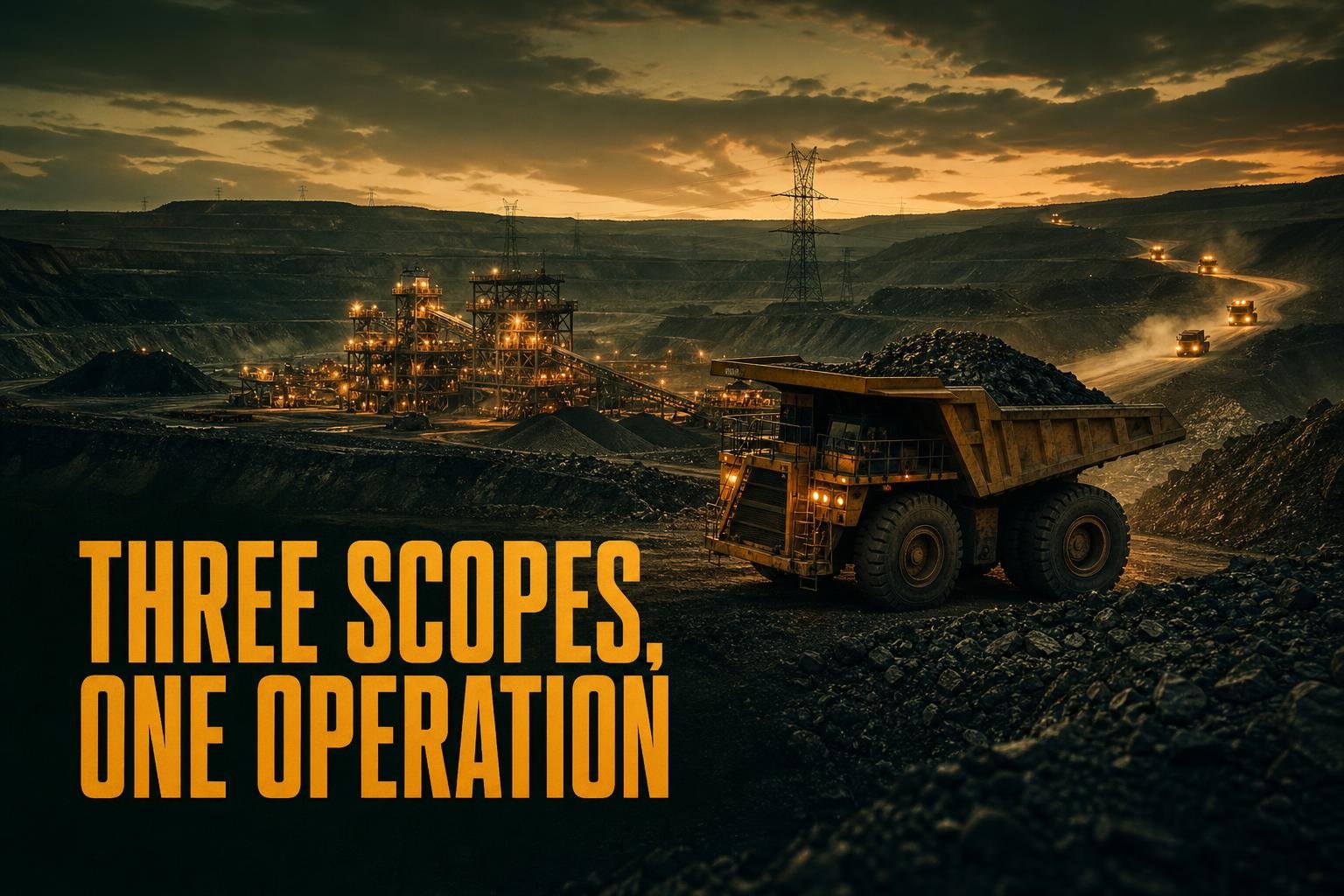
Scope 1, 2 and 3 are not three separate stories. They are one operation viewed through different lenses. The organizations that recognize this early will be better positioned to report with confidence, defend their numbers, and manage emissions as part of core operational control.